
Table of Contents
Answer Engine Optimization (AEO) is reshaping how blogs show up in search. If you want your content to appear in voice results, featured snippets, and AI tools like ChatGPT, you need more than traditional SEO—you need content that answers questions clearly and fast.
Think of AEO as designing your blog for both humans and machines. It’s about giving direct, structured answers that search engines can easily feature—and that readers can instantly trust.
In this post, I’ll show you how AEO works, why it matters for small business blogs, and the exact steps I use to help content rank and convert.
What is Answer Engine Optimization (AEO)?
AEO (Answer Engine Optimization) is the process of optimizing your content to answer specific user questions in a way that search engines, voice assistants, and AI tools can easily understand and feature.
AEO content is designed to be:
Clarity-first: Direct, concise answers
Structured for machines: H2s, bullets, and FAQs
Voice-friendly: Built for snippets and conversational search
Why AEO Matters for B2C Blogs and Websites
Most small business blogs are built for humans but not for machines. AEO bridges that gap—and unlocks visibility across platforms.
Here’s why it matters:
Featured snippets = higher visibility (top of Google, zero-click searches)
Voice assistants pull AEO-optimized answers
AI tools need structured, fact-based content to reference
If your content isn’t structured to answer, it’s likely being skipped—even if it’s good.
Pain Point Framing:
You’ve probably spent hours writing a blog… only to watch it get buried. AEO fixes that by aligning with how modern search tools rank content.
How to Apply AEO to Your Blog
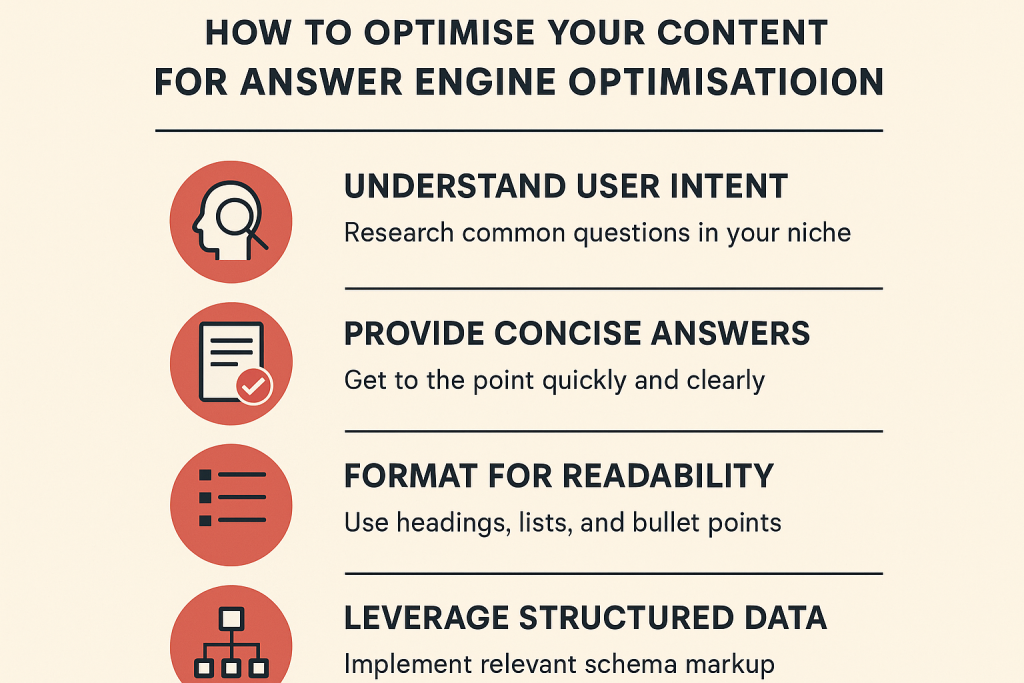
Here’s my framework to turn any blog into an AEO-optimized asset:
1. Identify Real Search Questions
Use tools like:
Google People Also Ask
AnswerThePublic
SEMrush or Ahrefs
Look for long-tail, conversational queries.
2. Answer First, Expand Later
Your opening paragraph should answer the query directly in 1–2 sentences.
3. Use Structured Formatting
H2s and H3s as subtopics
Bullets and numbered steps
Short, clear paragraphs
4. Include AEO Snippets and FAQs
Insert short answer boxes within the post (1–3 sentences) and add 3–5 FAQs with natural language.
5. Add Schema Markup
Use JSON-LD FAQPage schema to help Google categorize your answers.
Want your blog to show up in AI search and voice results?
Let’s optimize it for AEO together. Contact me today and let’s turn your blog into a high-converting content asset.
Common AEO Mistakes to Avoid
Writing long intros without answering the main question
Skipping headings and bullets
Forgetting schema markup
Answering vaguely instead of clearly
Not researching real user questions
These mistakes cost you visibility. AEO is about clarity, not cleverness.
My Proven AEO Strategy
Here’s the process I use with clients to boost content visibility:
Phase 1: Question Mining
I identify 10–20 real search questions using SEO tools and forums
Phase 2: Structure & Drafting
I design blog outlines using H2s, snippets, and bullets
Phase 3: Optimization
I add schema markup, internal links, and CTA layout aligned with user gaze paths
Phase 4: Performance Review
I track snippet wins, traffic, and CTR to refine the structure
This approach creates consistency and builds authority in your niche.
Ready to have me do this for your business? Let’s talk about your next blog.

FAQs About Answer Engine Optimization
What is Answer Engine Optimization?
- Answer Engine Optimization (AEO) means structuring content so search engines and AI tools can quickly find and feature it. It makes your answers more discoverable.
How is AEO different from SEO?
- AEO is a part of SEO but focuses specifically on answering questions in a clear, machine-readable format. SEO is broader—AEO is sharper.
Do small businesses need AEO?
- Yes. AEO helps small businesses get found in featured snippets, voice results, and AI search—without needing big budgets or backlinks.
How do I implement AEO?
- Start by identifying user questions, then format your blog with clear answers, headings, bullets, and schema markup.
Final Thoughts
If your content isn’t structured for the way people (and machines) search, it’s invisible.
AEO turns your blog into an asset that ranks, builds trust, and drives action.
Want help making your blog AEO-ready? Contact me to get started or book a free clarity call. Let’s make your content easier to find, understand, and convert.