

If you are a chiropractor and your appointment book is quieter than you would like, you have probably already asked yourself: is it the economy? Is it competition? Am I doing something wrong? If you have been asking why am I not getting new chiropractic patients despite years of delivering excellent care, you are not alone. It is one of the most common questions clinic owners are searching for answers to right now. And in most cases the answer is not what they expect. The problem is not your skills. It is not your pricing. The real reason most chiropractic clinics are not getting enough new patients in 2026 is this: patients in pain are Googling right now and they cannot find you. Why Chiropractors Are Not Getting New Chiropractic Patients When a patient wakes up with lower back pain, they do not wait for a referral. They pick up their phone and search. Research consistently shows that 3 out of 4 patients search online before booking any healthcare appointment. A real Gauteng patient left this review about how she found her chiropractor: “I was so despondent about my back pain I really did not know what to do anymore. I decided to Google for options, found the website, read the reviews and phoned for an appointment.” That patient is your ideal patient. She is motivated to book. The question is whether she finds your clinic or your competitor’s. How Patients Find a Chiropractic Clinic Online Understanding the patient journey is the foundation of understanding why you are not getting new chiropractic patients despite being excellent at your work. Step 1: They search on Google. They type “chiropractor near me” or “chiropractor in Midrand.” They do this on their phone, while sitting in pain, in under 30 seconds. Step 2: They see the Google Maps 3-pack. Google shows them three local clinic listings. These three results get the overwhelming majority of clicks. If your clinic is not in those three spots, most patients never see your name. Understanding exactly how Google decides who appears in those three spots is worth reading in detail, we cover it fully in how chiropractor near me searches work in Johannesburg. Step 3: They check reviews. 93% of patients say online reviews influence their choice of healthcare provider. A clinic with fewer than 10 reviews or fewer than 4 stars gets skipped. A clinic with no reviews gets ignored entirely. Step 4: They visit the website. Patients make a decision about a website within 7 seconds. A slow or outdated site sends them straight back to Google. Step 5: They book. The clinic with the clearest, most professional, most mobile-friendly experience wins the patient. The chiropractic clinics filling their appointment books are not necessarily the best clinics. They are simply the easiest to find and trust online. The 3 Reasons You Are Not Getting New Chiropractic Patients from Google Reason 1: No website or an outdated one. More than 80% of patients search on their phones. A website that is not mobile-friendly is effectively invisible. Google also penalises poorly performing websites by ranking them lower in search results. Even referrals Google your name before calling. Without a professional website, you will keep asking why am I not getting new chiropractic patients because patients who were already half sold on choosing you are booking elsewhere. It is also worth knowing that having a website does not automatically mean patients will find it. Many chiropractic clinics have websites that simply do not rank. We explore the specific reasons why in why your Johannesburg chiropractic clinic has a website but no new patients are coming from Google. Reason 2: An incomplete Google Business Profile. Your Google Business Profile is your clinic’s digital front door. If it says “Add website” or “Be the first to review,” Google ranks you lower than competitors with complete profiles. Missing photos, incorrect hours, and no services listed all hurt your local visibility. Reason 3: Too few Google reviews. Reviews are not just social proof. They are a confirmed local ranking factor in 2026. A clinic with fewer than 20 recent Google reviews is at a significant disadvantage. 56% of patients will not consider a provider with a rating below 4.0 stars. This is not about gaming the system. It is about making the excellent care you already deliver visible and verifiable online. Why Word of Mouth Is No Longer Enough to Get New Chiropractic Patients in Gauteng Word of mouth built most chiropractic practices. Referrals are still valuable. But here is the shift: when a friend refers a patient to your clinic, that patient Googles your name before calling. They read your reviews. They visit your website. If what they find does not match the trust their friend placed in you, some book elsewhere. Word of mouth brings patients to the Google search. Your online presence closes the decision. If your referrals are slowing down and you are wondering how to get more chiropractic patients without relying solely on word of mouth, the answer starts with your Google presence. Many clinic owners consider running paid advertising to fill the gap. Paid ads can play a short-term role but they stop working the moment the budget runs out. If you want to understand the honest difference between what SEO builds versus what ads rent, we cover both in detail in SEO vs Google Ads for chiropractic clinics in South Africa. Frequently Asked Questions About Getting New Chiropractic Patients in Gauteng Why am I not getting new chiropractic patients even though I have been in practice for years? The most common reason established chiropractors stop growing is not reputation or skill. It is visibility. As patient behaviour has shifted to online search, clinics without a strong digital presence are invisible to the majority of new patients looking for care in their area. Does a chiropractic clinic need a website if it is already on Google Maps? Yes. A Google Business Profile listing and a

Chiropractic Clinic Website Not Ranking? Here Is Why
You built the website. You made sure it looked professional, listed your services, and had a contact form. Someone told you a website was enough to start showing up on Google, so you launched it and waited. The phone still rings from referrals and walk-ins. But Google is sending you nothing. If your chiropractic clinic website is not ranking in Johannesburg, you are not alone and you are not imagining it. Having a website and being visible on Google are two entirely different things, and the gap between them is costing Johannesburg chiropractic clinics new patients every single day. The good news is that the reasons are almost always identifiable and fixable. Here are the five most common ones we find when auditing chiropractic practices across Johannesburg and Gauteng. 5 Reasons Your Chiropractic Clinic Website Is Not Ranking in Johannesburg Reason 1: Your Google Business Profile Is Incomplete and Inactive Over 85% of chiropractic patients start their search online using local terms like “chiropractor near me” or “chiropractor Johannesburg.” Most of them never reach your website on the first search. They see the Google Maps results, look at the three clinics listed there, and call one of them. Your Google Business Profile determines whether your practice appears in those three spots. A profile that was filled in when you first opened and left untouched is sending Google a very weak signal. Google rewards GBP listings that are complete, active, and consistent. That means a keyword-informed business description, an accurate service list, regularly updated photos, and a weekly posting cadence. It means your business category is set correctly, your hours are current, and your phone number matches every other directory listing your practice has online. When any of these elements are missing or out of date, your profile loses ground to competitors who are actively managing theirs — even competitors who have been open for fewer years and see fewer patients. Understanding exactly how Google decides which three clinics appear in those Maps results is worth reading in detail. We cover the full mechanics in how chiropractor near me searches work in Johannesburg. Reason 2: Your Website Has No Suburb-Specific Content A patient in Fourways searching “chiropractor Fourways” will not be matched to your website if your site only ever mentions “Johannesburg” in broad terms. Google needs specific signals that tell it exactly which areas your practice serves and which conditions you treat. A website that says “we help patients across Johannesburg” is too vague. It costs you rankings for every suburb-specific search in your area. The practices ranking in the top results for location-specific chiropractic searches in Johannesburg have pages or sections that speak directly to those locations. They mention the suburb by name in their headings and content. They address the kinds of patients who live and work in that area. This is not keyword stuffing. It is giving Google the geographic context it needs to match your practice to the right searchers. Reason 3: Your Website Loads Too Slowly on Mobile Approximately 70% of chiropractic searches happen on mobile devices. A patient with an aching back is almost always reaching for their phone, not their laptop. If your website takes more than 3 seconds to load on a mobile connection, a large proportion of those potential patients leave before reading a single word about your practice. This matters for two reasons. The first is obvious — people who leave before your site loads cannot book an appointment. The second is less visible but equally damaging. Google measures how users interact with pages in its search results. A page that people consistently click on and immediately leave sends Google a clear message that the page is not worth showing. That behaviour quietly drags your ranking down over time in a way that is almost impossible to notice without a proper technical audit. If your chiropractic clinic website is not ranking in Johannesburg, slow mobile load speed is one of the first things we check. It is one of the most common culprits and one of the most overlooked. Reason 4: Google Cannot Read or Understand Your Website There is a layer of your website that is invisible to your patients but entirely visible to Google. It is the technical structure that tells search engines what your site is about, who it is for, and where your practice is located. Most chiropractic clinic websites built by general web developers are missing critical elements of this structure. Schema markup, which is code that tells Google you are a chiropractic practice at a specific address in Randburg or Sandton, is absent from the majority of health clinic websites we audit. Title tags are set to generic defaults or left blank. Meta descriptions are missing. Page headings do not include the condition names or suburb names that patients are actually searching. None of these affect how your website looks to a visitor. They are all invisible. But to Google they are primary signals used to understand what your site is about and whether it is relevant to a given search. A chiropractic clinic website without them is like a shop with no sign on the door. You are open but Google does not know what you sell or where you are. We cover this in full detail in our guide to why chiropractors in Gauteng are not getting new patients from Google. Reason 5: Your Practice Name, Address, and Phone Number Are Inconsistent Online This one surprises most clinic owners. If your practice is listed as “Northgate Chiropractic Clinic” on Google but “Northgate Chiro” on an online directory, and your phone number on your website uses a different format to the one on your GBP listing, Google loses confidence in the accuracy of your business information. That erosion of confidence hurts your local rankings in a way that is entirely invisible. You will not receive any notification that it is happening. The rankings simply sit lower than they should while the cause

How “chiropractor near me” searches work in Johannesburg
Have you ever searched your own chiropractic clinic on Google and found a competitor sitting above you in the results? A practice with fewer years in operation, fewer reviews, and a simpler website than yours, ranking ahead of you for the exact patients you are trying to reach. If that has happened to you, you are not imagining things, and it is not a reflection of the quality of care your clinic provides. It happens to well-run chiropractic practices in Johannesburg every single day, and the reason almost never comes down to clinical reputation. It comes down to a set of signals your practice may not be sending to Google. “Chiropractor near me” is searched approximately 8,100 times every month across South Africa. The three practices that appear at the top of those results capture the overwhelming majority of those clicks. Positions four and below receive a fraction of the attention, and most patients in pain never scroll that far. Understanding how Google chooses those top three is the first step to knowing what your clinic needs to do to get there. What actually happens when someone searches “chiropractor near me” in Johannesburg When a patient in Sandton types “chiropractor near me” into their phone, Google does not simply pull up the nearest practice to their location. It runs an evaluation against hundreds of signals in a fraction of a second, and the result is what you see at the top of every local search — three chiropractic clinics displayed on a map with their star ratings, hours, and a direct call button. This is known as the Google Maps 3-Pack, and it sits above every other result on the page. That placement matters more than most clinic owners realise. Before any patient ever reaches your website through a standard search, they are already looking at those three listings. Businesses in those top three positions receive around 93% of all clicks from local searches. If your clinic is not one of them, the vast majority of patients searching for a chiropractor in Johannesburg right now will never find you, regardless of how good your practice is or how long you have been open. How Google decides which three clinics appear Google uses three primary factors when determining who shows up in local search results. The first is relevance, which is how well Google believes your practice matches what the patient searched for. This is shaped by the information on your Google Business Profile, your business category, your service descriptions, the keywords in your profile, and the content on your website. A practice whose profile clearly explains that it treats back pain, sciatica, and sports injuries in Sandton will be seen as more relevant for those searches than a practice with a vague or incomplete profile. Relevance is almost entirely within your control, which makes it one of the highest-leverage things a clinic can work on. The second factor is distance, which is how close your practice is to the location implied by the search. When someone in Fourways searches “chiropractor near me”, Google uses their GPS location to identify nearby practices. When someone searches “chiropractor Sandton” from across the city, Google interprets the relevant geography as the Sandton area and surfaces practices physically closest to that location. You cannot change where your clinic is, but strong optimisation across the other two factors can meaningfully extend the radius in which your practice appears, allowing you to show up for patients searching slightly further than your immediate area. The third factor is prominence, which is how authoritative and well-established your practice appears to Google across the web. This is built through the volume and recency of your patient reviews, whether you respond to those reviews, how consistently your clinic name and address appear across South African directories, and how well your website performs as a supporting signal for your local presence. A practice that has been steadily collecting reviews, maintaining consistent business information, and keeping an active Google Business Profile will outrank a practice that set everything up two years ago and left it untouched, even if the inactive one has more total reviews sitting there. Why a competitor with fewer reviews can outrank your practice This is the question that frustrates most chiropractic clinic owners, and the answer is almost never the reviews themselves. A competitor sitting above you in the Map Pack with half your review count is typically winning on relevance or prominence signals that have nothing to do with star ratings. The most common pattern we see when looking at chiropractic clinics in Johannesburg that cannot break into the top three is this. The higher-ranking clinic has a fully completed Google Business Profile with a keyword-informed description, a detailed service list, recent photos, and a consistent posting history. The lower-ranking clinic, often a practice with genuinely better patient outcomes, has a profile that was set up when the practice opened and has barely been touched since. Another pattern is inconsistent business information across directories. If your clinic name, address, or phone number appears slightly differently on different platforms, Google interprets that inconsistency as uncertainty about where your practice is and what it does, which erodes your local authority quietly over time. Your website also plays a direct role. Google cross-references your Business Profile with your website to validate the location and service signals you are claiming. A clinic website that loads slowly on mobile, lacks suburb-specific content, or has no condition-specific pages is weakening the very foundation your GBP relies on to perform in local results. What this means for your chiropractic practice in Johannesburg The practices ranking at the top of Johannesburg local searches right now are not necessarily the best clinics in the city. They are the clinics that have been most deliberate about how they present themselves to Google. Relevance and prominence, the two factors you can directly influence, are also the two that move the needle fastest when they are properly addressed. None
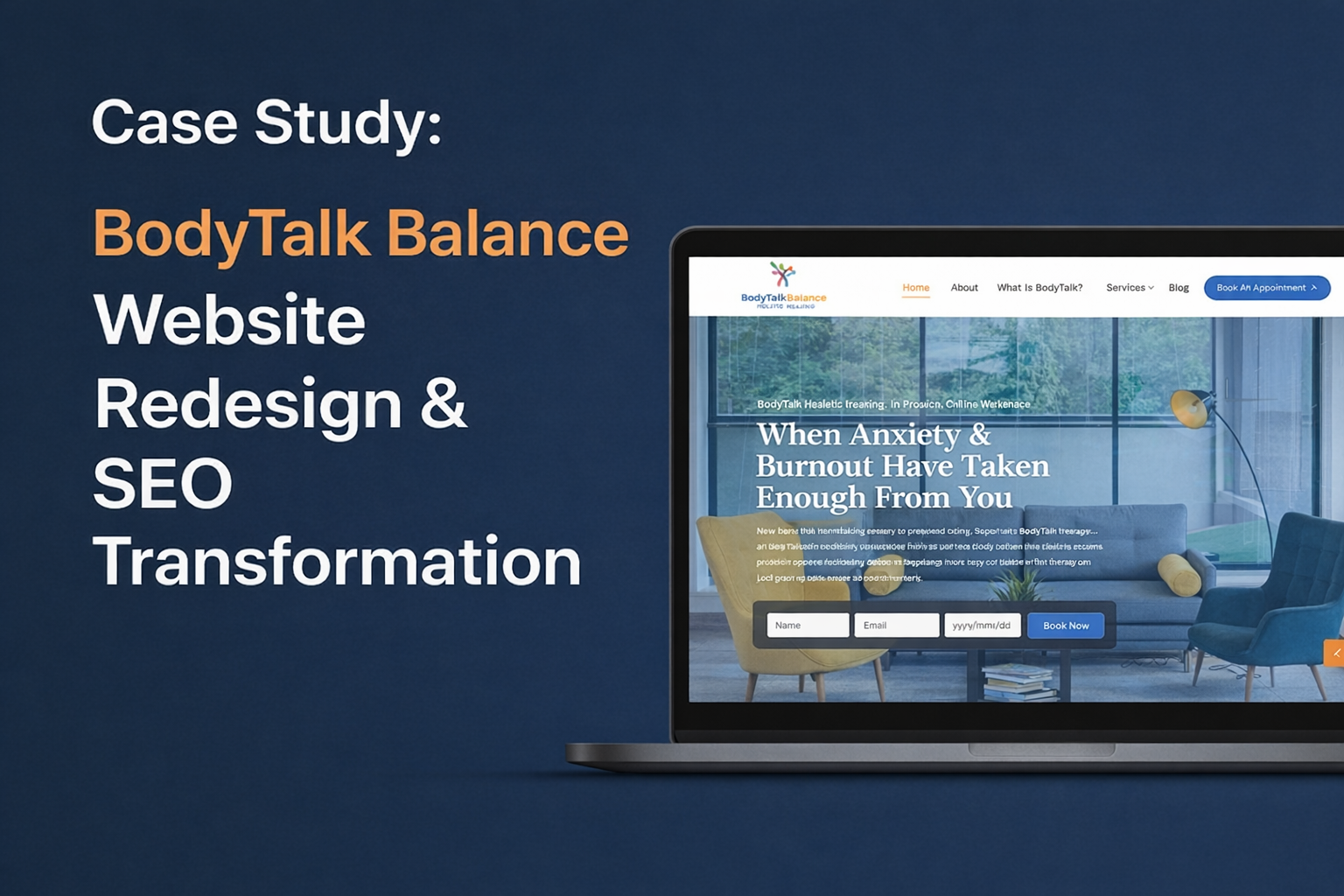
BodyTalk Balance — Web Design & SEO Case Study
Client Overview BodyTalk Balance is a holistic healing practice run by Elana Sissison — a certified BodyTalk practitioner, Quantum Touch practitioner, and Holistic Life Coach based in Johannesburg, South Africa. Elana has lived with anxiety for over 40 years — the first 12 experiencing acute daily anxiety, and the past 28 with it managed. That lived experience is the foundation of her practice and her most powerful differentiator. She offers in-person sessions in Johannesburg and fully effective distance healing sessions to clients anywhere in the world via video call or photograph. Her challenge? A website that didn’t reflect her credibility, failed to speak to her ideal clients, and was invisible to both local and international searchers — despite generating thousands of Google impressions every month. The Challenge When BodyTalk Balance came to us, the website had five major problems: Outdated Design – the look and feel were dated, hurting user trust. Poor SEO – the site had little to no keyword optimization, weak metadata, and no visibility for South African searches. Low Engagement – Users visiting the site couldn’t easily find information or ways to take action, leading to missed opportunities. The Solution SEO & Web Development with Ntsakisi rebuilt BodyTalk Balance’s website from the ground up — focusing on strategy, SEO, content, schema markup, and modern UI design across five fully optimised pages. 1. Strategy & Persona Development We started with data, not assumptions. A Google Search Console audit revealed thousands of impressions with almost no clicks — a relevance problem, not a traffic problem. We developed three client personas and built the entire project around one key strategic decision: Global at First Glance, Local by Choice — a homepage that speaks to international visitors while keeping all local SEO signals exactly where Google needs them. 2. SEO Optimisation Optimised meta titles, descriptions, and headings with targeted keywords across all five pages Built a four-tier keyword architecture — commercial, problem-aware, education, and location Rewrote all meta descriptions as mini advertisements — pain first, solution second, call to action third Added structured data across all website pages for full Answer Engine Optimisation 3. Content & Copywriting Rewrote all copy from scratch across the website pages Shifted from talking about BodyTalk to talking to the person who needs it Developed the Anxiety Alchemist positioning — ownable, memorable, impossible to replicate Built a recognition section using six statements that mirror the target audience’s exact internal monologue Applied a CTA temperature ladder — matching the ask to where the visitor is emotionally at each point on the page 4. Schema & AEO Optimisation Built ten schema blocks across the website FAQPage schema on the pages targeting high-impression queries for Featured Snippet placement All FAQ content written so AI tools like ChatGPT and Google’s AI Overview can cite it directly 5. Modern UI Design Built a clean, editorial design system anchored in the client’s existing brand colours Fully consistent pages with shared navigation, footer, and CTA structure The Results Since completing the BodyTalk Balance website build, the practice now has: Global Visibility — Optimised for both local Johannesburg searches and international queries including BodyTalk online sessions, anxiety coach online, and holistic healing for anxiety — reaching potential clients in the UK, Canada, Australia, the Middle East, and beyond Stronger Credibility — Professional design, Elana’s personal story positioned prominently, credentials clearly displayed, and the Anxiety Alchemist brand identity owning a unique space in the wellness market AI Search Presence — FAQPage schema and AEO-optimised content positions BodyTalk Balance to be cited directly by Google’s AI Overview and tools like ChatGPT when users ask questions about BodyTalk therapy Conversion-Ready Structure — Seven strategically placed CTAs per page, a free discovery call pathway that reduces booking friction, and a full international payment flow explanation that removes the biggest hesitation point for global clients A 24-Hour Booking Platform — A website that works as hard at 2am for a woman in London as it does at 10am for a woman in Johannesburg Ready to turn your website into a lead-generating machine? Don’t let an outdated site hold your business back. Let SEO with Ntsakisi redesign your website for visibility, credibility, and conversions — so your ideal clients find you and take action. Book Your Free Consultation Today FAQs How can SEO with Ntsakisi help my business grow? We build websites that don’t just look professional, they attract visitors, build trust, and convert them into leads using SEO, local optimization, and clear calls-to-action. Why should I choose SEO with Ntsakisi over other agencies? Our unique approach combines SEO strategy, web development, and lead generation. This ensures your website ranks higher, engages visitors, and drives real business results. Can you improve my outdated website? Absolutely. We redesign websites to reflect credibility, simplify navigation, and optimize for search engines — so your site generates leads and builds authority. How quickly will I see results? SEO takes time for organic rankings, but our websites are conversion-ready from day one. Clear forms, CTAs, and structured content help capture leads immediately. How do I get started with SEO with Ntsakisi? Contact us today for a tailored website audit and strategy. We’ll show you exactly how to increase visibility, engage users, and turn your website into a lead-generating platform. We build websites that don’t just look professional, they attract visitors, build trust, and convert them into leads using SEO, local optimization, and clear calls-to-action. Our unique approach combines SEO strategy, web development, and lead generation. This ensures your website ranks higher, engages visitors, and drives real business results. Absolutely. We redesign websites to reflect credibility, simplify navigation, and optimize for search engines — so your site generates leads and builds authority. SEO takes time for organic rankings, but our websites are conversion-ready from day one. Clear forms, CTAs, and structured content help capture leads immediately. Contact us today for a tailored website audit and strategy. We’ll show you exactly how to increase visibility, engage users, and turn your website into a lead-generating platform. Conclusion

How to Rank Your Dental Practice on Google Maps
When someone searches “dentist near me”, “emergency dentist Johannesburg” or “teeth cleaning Sandton”, they don’t scroll endlessly, they click one of the top 3 map results. If your dental practice isn’t showing there, you’re invisible to high-intent patients. In this guide, you’ll learn exactly how to rank your dental practice on Google Maps in South Africa — and how to turn visibility into bookings. What Is Google Maps Ranking for Dentists? When patients search for a dentist locally, Google shows a map section with three clinics at the top. This is called the Google 3-Pack. It appears above normal website results. Ranking here means: More calls More direction requests More bookings More walk-ins Think of it like having your dental clinic placed on the busiest street in your city — instead of hidden down a side road. Why Most Dental Practices Don’t Rank on Google Maps Many clinics assume having a website is enough. But Google Maps ranking depends heavily on: Google Business Profile optimization Reviews and review velocity Location signals Website authority Consistent business information Without proper dental local SEO, even established clinics struggle to appear. This is where strategic SEO for Dentists South Africa becomes critical. Learn more about our complete SEO for Dentists South Africa strategy. 7 Steps to Rank Your Dental Practice on Google Maps in South Africa 1. Fully Optimise Your Google Business Profile Your Google Business Profile (GBP) is the foundation. Most dentists: Leave categories incomplete Don’t optimise services Ignore descriptions Never post updates Your profile should include: Primary category: Dentist Secondary categories (Cosmetic Dentist, Emergency Dentist, etc.) Keyword-optimised service descriptions Location references Weekly posts This tells Google exactly what you do and where you operate. Learn how to optimise Google Business Profile. 2. Target Location-Specific Keywords Instead of only targeting: “Dentist” You should optimise for: Dentist in Johannesburg Family dentist Sandton Emergency dentist Pretoria Teeth whitening Randburg Location signals increase your chances of appearing in local searches. This applies to: Your GBP Your website Your service pages Your blog content 3. Build High-Quality Reviews Consistently Google prioritises: Number of reviews Review frequency Keyword mentions in reviews Response rate Encourage patients to mention services naturally: Instead of: “Great service.” Encourage: “Great emergency dentist in Midrand.” Those location mentions strengthen your map ranking. Learn how online reviews influence local customers and boast sales. 4. Optimise Your Website for Local SEO Google doesn’t rank your Google Business Profile alone. It checks your website to confirm credibility. Your dental website should include: Location pages Structured data (schema markup) Fast loading speed Mobile optimisation Clear contact information This is why proper dental search engine optimisation matters beyond just maps. 5. Maintain NAP Consistency NAP = Name, Address, Phone Number. If your clinic is listed differently across directories, Google loses trust. Ensure your details are identical on: Your website Google Health directories Local business listings Consistency builds authority. 6. Use Google Posts Weekly Most dentists ignore this. Google Posts: Improve engagement Show activity Increase click-through rates Post about: Teeth whitening Oral hygiene tips Promotions Before & after transformations New equipment Fresh activity signals relevance. 7. Track Calls, Clicks & Bookings If you’re not tracking: Calls from Google Maps Direction requests Website clicks You can’t measure growth. Professional SEO for dentists in South Africa includes full tracking and reporting so you know exactly what’s working. How Long Does It Take to Rank on Google Maps? It depends on: Competition in your city Current optimisation level Review strength Website authority Most dental clinics see measurable improvements within 3–6 months when done properly. Google Maps ranking isn’t instant. But once you rank, visibility compounds. Why Google Maps SEO Is Critical for Dental Clinics Patients searching locally are not browsing. They’re ready to book. Ranking in Google Maps means: You capture intent You build credibility instantly You reduce reliance on paid ads You create predictable patient flow If your competitor ranks above you, they’re receiving those bookings. Want to See Where Your Dental Clinic Currently Ranks? We offer a free dental SEO audit where we analyse: Your Google Maps visibility Your review strength Your keyword positioning Your website performance Your local SEO gaps Start with our full SEO for Dentists South Africa strategy page to see how we grow clinics. Or… Book Your Free Dental SEO Audit Today Let’s position your clinic where patients are already searching.

Polico Africa Website Redesign & SEO Transformation
Client Overview Polico Africa is a Financial Services Provider (FSP 4598) and a trusted short-term insurance administrator in South Africa. Since 2006, they’ve supported brokers with compliant, reliable administration services across personal, commercial, and engineering insurance. Their challenge? A website that didn’t match their credibility, failed to explain services clearly, and wasn’t optimized for search engines or conversions. The Challenge When Polico Africa came to us, their old website had three major issues: Outdated Design – the look and feel were dated, hurting user trust. Poor SEO – the site had little to no keyword optimization, weak metadata, and no visibility for South African searches. Low Engagement – brokers visiting the site couldn’t easily find information or ways to take action, leading to missed opportunities. The Solution SEO & Web Development with Ntsakisi redesigned Polico Africa’s website from the ground up, focusing on SEO, GEO (local relevance), and AEO (answer engine readiness). 1. Modern Redesign & UX Built a clean, professional, mobile-friendly layout. Simplified navigation so brokers can quickly find services. Added strong calls-to-action for enquiries and broker partnerships. 2. SEO Optimization Optimized all meta titles, descriptions, headings, and content with keywords like short-term insurance administrator South Africa and insurance website redesign. Structured content with H1–H3 for clarity and SEO. Implemented Local SEO so searches for insurance administrator South Africa lead to Polico Africa. Added structured data (FAQ & LocalBusiness schema) for Answer Engine Optimization (AEO). 3. Content & Trust Signals Expanded product/service descriptions for commercial, engineering, and personal insurance. Highlighted 20+ years of experience and compliance (FSP 4598). Showcased partnerships with trusted insurers: Old Mutual, Hollard, Yardrisk, Bryte, New National. 4. Conversion & Lead Generation Integrated enquiry forms and CTAs to drive action. Created a “Become a Broker Partner” pathway to generate broker leads. Designed pages with a clear flow: awareness → trust → action. The Results Since launching the new website, Polico Africa has seen measurable improvements: Improved Visibility: Optimized for insurance related searches. Stronger Credibility: Professional design and trust signals reflect authority. Better Engagement: Clear navigation and mobile design keep users on-site longer. Lead Generation: Contact forms and CTAs created a smoother path for brokers to connect Ready to turn your website into a lead-generating machine? Don’t let an outdated site hold your business back. Let SEO with Ntsakisi redesign your website for visibility, credibility, and conversions — so your ideal clients find you and take action. Book Your Free Consultation Today FAQs How can SEO with Ntsakisi help my business grow? We build websites that don’t just look professional, they attract visitors, build trust, and convert them into leads using SEO, local optimization, and clear calls-to-action. Why should I choose SEO with Ntsakisi over other agencies? Our unique approach combines SEO strategy, web development, and lead generation. This ensures your website ranks higher, engages visitors, and drives real business results. Can you improve my outdated website? Absolutely. We redesign websites to reflect credibility, simplify navigation, and optimize for search engines — so your site generates leads and builds authority. How quickly will I see results? SEO takes time for organic rankings, but our websites are conversion-ready from day one. Clear forms, CTAs, and structured content help capture leads immediately. How do I get started with SEO with Ntsakisi? Contact us today for a tailored website audit and strategy. We’ll show you exactly how to increase visibility, engage users, and turn your website into a lead-generating platform. We build websites that don’t just look professional, they attract visitors, build trust, and convert them into leads using SEO, local optimization, and clear calls-to-action. Our unique approach combines SEO strategy, web development, and lead generation. This ensures your website ranks higher, engages visitors, and drives real business results. Absolutely. We redesign websites to reflect credibility, simplify navigation, and optimize for search engines — so your site generates leads and builds authority. SEO takes time for organic rankings, but our websites are conversion-ready from day one. Clear forms, CTAs, and structured content help capture leads immediately. Contact us today for a tailored website audit and strategy. We’ll show you exactly how to increase visibility, engage users, and turn your website into a lead-generating platform. Conclusion This project shows how SEO with Ntsakisi blends SEO strategy with web development to deliver more than just a website, we create growth platforms. Polico Africa’s new website now reflects their credibility, builds trust with brokers, and is optimized for visibility and conversions in South Africa’s competitive insurance market. If your business is struggling with an outdated website that doesn’t bring in leads, let’s talk about how we can transform yours too. Get in touch NOW!

What Does a Website SEO Consultant Do? And Do You Need One?
Table of Contents If your website looks great but doesn’t show up on Google, this post is for you. You’re probably wondering: “What exactly does an SEO consultant do—and do I really need one?“ Let’s break it down. As a website SEO consultant, I help B2C, B2B businesses (like yours) get found online, attract better traffic, and turn visitors into paying clients—without running expensive ads. In this blog, you’ll learn what a website SEO consultant actually does, how it benefits your business, and how to know if it’s time to hire one. What Is a Website SEO Consultant? A website SEO consultant is a professional who helps businesses improve their search engine visibility. They optimize your site so that it ranks higher in search results for the keywords your ideal customers are using. In simple terms: I help your website show up, get clicked, and convert. Why Hiring a Website SEO Consultant Matters for Your Business Your dream customers are searching online—right now. If you’re not showing up, you’re invisible. Here’s why working with an SEO consultant is a smart move: Get Found Faster: A properly optimized site means Google knows what you offer. Drive High-Intent Traffic: You attract people who are already looking for your services. Improve Sales Without Ads: Organic traffic compounds over time and costs less. Fix What’s Holding You Back: From slow load times to bad metadata, I catch what others miss. Gain a Competitive Edge: Most of your competitors either guess or give up. You won’t. What Does a Website SEO Consultant Do? Here’s a breakdown of what I (and top SEO consultants) typically do: Audit Your Site: I uncover what’s broken, slow, or confusing to users and Google Keyword Research: Find what your ideal clients are typing into Google On-Page SEO: Optimize titles, content, images, URLs, and internal links Technical Fixes: Improve speed, structure, mobile usability, and crawlability Content Strategy: Help you write or improve blogs, service pages, and FAQs Analytics & Tracking: Set up data to track what’s working and where to grow Want to find out exactly what’s holding your site back? Request a Free SEO Check-In Common Mistakes I See and How a Consultant Fixes Them Too many business owners waste time and money with these mistakes: Launching a website without SEO built in Using the wrong keywords that clients aren’t searching for Stuffing keywords and hurting readability Ignoring slow load times, which kills rankings and conversions No metadata, alt text, or internal links (Google hates this) Tip: Think of SEO like the foundation of your online house. No point decorating the inside if Google can’t find the front door. FAQs About Website sEO consultant What does a website SEO consultant do? An SEO consultant improves your website’s content, speed, and structure so it ranks better in Google and drives more qualified leads. Do small businesses need an SEO consultant? Yes. If your website isn’t showing up or converting, an SEO consultant can uncover hidden issues and turn your site into a sales tool. How long does SEO take to work? Most websites see meaningful SEO results within 3–6 months with consistent effort. What’s the difference between an SEO consultant and an agency? An SEO consultant offers 1-on-1, personalized strategy. Agencies often work at scale with templated approaches. Consultants are ideal for custom solutions and faster pivots. How much does it cost to hire a website SEO consultant? Costs vary, but you should expect value—not just tasks. I offer custom pricing based on goals, starting with a free call. Can I do SEO myself without a consultant? You can learn some basics, but without the right tools and strategy, you may waste time or cause harm. A consultant prevents that and gets faster results. What kind of businesses benefit most from SEO consulting? Local businesses, e-commerce shops, wellness brands, and service providers who want consistent leads without relying on ads. Will I need to redesign my website for SEO? Not always. Often, small tweaks can make a huge difference. I always start with what you already have. Ready to Turn Your Website Into a Sales Machine? Your competitors are ranking—and getting calls—while you’re reading this. Let’s fix that. Book Your Free SEO Call Now and I’ll show you exactly what to change, improve, or fix to grow your traffic and leads. No pressure. Just clarity.

Case Study: Local SEO Strategy for a Multi-Location Pediatric Therapy Clinic
Background Industry: Pediatric Therapy / Healthcare Problems A growing pediatric therapy clinic with 3 locations needed to increase visibility and bookings in competitive suburbs Newly launched website lacked technical SEO, structured data, and conversion-focused UX Google Business Profiles incomplete and under-optimized across locations No visibility in Google Search or Maps Solutions Technical SEO Foundation Comprehensive audit and fixes for crawlability, metadata, schema, sitemap, and indexing Local SEO Strategy Optimized Google Business Profiles with city-specific descriptions and service categories Implemented review generation system Aligned website location pages with GBPs for local rankings On-Page Optimization Rewrote metadata and page copy with intent-focused keywords Added strong CTAs on key pages Planned homepage trust elements (bios, testimonials, FAQs) Tracking & Analytics Set up GA4 event tracking and heatmaps Monitored user behavior to improve conversions Drive Results, Not Just Rankings Want local SEO that brings leads, not just traffic? Book a Free 15-Minute Consultation

How I Went From Just Being a Web Developer to Becoming an SEO Specialist — Without Giving Up Coding
Table of Contents I was reflecting the other day on my journey—how I started as a full-time web developer and gradually shifted into SEO specialist territory, without ever really leaving the coding behind. I wanted to share this story because I know many business owners, marketers, and startups out there feel overwhelmed trying to figure out SEO or how to grow online. Maybe my path can offer some clarity or inspiration. Right now, I’m writing this from my home office—a small but cozy space filled with a couple of monitors, code editors open on one screen, and keyword research tools on the other. This balance between coding and SEO strategy is where I’ve found my groove. If you want to know more about who I am and how I blend web development with SEO to help businesses grow, check out my profile here and see how I can support your online journey. Where Did It All Begin? When I started my career, I was all about building websites. Clean code, fast loading, smooth user experience — that was my world. But pretty quickly, I saw something missing. Clients were asking: “Why isn’t my site getting traffic? How do I get more leads?” I realized: knowing how to build a website isn’t enough. You also need to know how to get it found. That’s when I started diving into SEO. I learned how Google works, how to research keywords that customers actually search for, and how to optimize every page for those keywords. The more I learned, the more I applied it — both to my clients’ sites and my own projects. If you’re ready to get your website working harder for your business, take a look at the services I offer and how I can help you with SEO, web development, or both. Why I Still Do Web Development Most SEO specialists don’t write code. Most web developers don’t dive deep into SEO. But I realized keeping both in my toolkit lets me fix problems fast and build sites optimized from the ground up. When I build a website now, I’m thinking: How fast is this site going to load? Is it mobile-friendly? Are the URLs and metadata optimized? Can I add structured data to help Google understand this better? This technical foundation means I’m not waiting on a developer or an SEO expert separately. I’m both. That’s the power of blending these skills. Ready to build a website that’s fast, SEO-friendly, and built to convert?Get in touch through my contact page and let’s make it happen. How SEO Changed My Approach—and Can Change Yours Too Understanding SEO made me see websites differently—not just as code, but as living business assets that need to attract and convert real customers. I began helping clients improve visibility, generate leads, and get measurable ROI from their sites. The journey wasn’t overnight. I faced challenges, stayed up late learning new tools, and experimented with strategies. But the results spoke for themselves. I helped startups and small businesses in healthcare, legal, tech, and e-commerce grow their presence online—often turning their websites from silent brochures into active sales engines. Want the same for your business? I design and develop websites that do more than look good — they load fast, rank well, and help you convert. Whether you’re starting fresh or ready for a full upgrade, I’ll help you build a website that actually works for your goals. Explore my Website Development services and let’s build something that drives results. Why Combining SEO and Web Dev Makes Me More Effective Here’s what I recommend if you’re a business owner or marketer: don’t separate these two worlds. Fast, clean websites rank better in Google — that’s my developer hat speaking. SEO strategy tells you what content to create, how to structure it, and how to attract your ideal customers — my SEO hat. When I do both, I save clients time and money because they don’t need to hire two separate people. For example, I recently helped a local medical aesthetics clinic grow their organic traffic by 45% in 5 months — just by optimizing their site speed, fixing technical SEO issues, and targeting local keywords. How This Helps You and Your Business If you’re feeling overwhelmed about SEO, I get it. It’s confusing, technical, and often seems like magic only experts understand. Here’s what I suggest you focus on today: Make sure your website loads quickly and works well on phones (mobile-first). Claim and optimize your Google Business Profile to get found locally. Research 3–5 keywords your customers search for and use them naturally in your website copy. Monitor your site’s traffic using Google Analytics to track what’s working. If you want, I can help you do all this and more — so you can focus on what you do best, running your business. Want Help Growing Your Business? SEO doesn’t have to be overwhelming. With the right guidance, you can get more leads, sales, and ROI from your website — even if you don’t know where to start. Book a free 30-minute strategy call with me today. Let’s talk about your business goals and create a simple, practical plan to grow your online presence. Quick Answers to Common Questions About Web development and SEO Does being a web developer help with SEO? Absolutely. Knowing how websites are built makes it easier to implement technical SEO changes that improve site speed, structure, and user experience—all critical for ranking well. How can SEO and web development skills work together? When combined, you can optimize your site from the ground up, ensuring both the content and the technical backend meet SEO best practices. This saves time and drives better organic growth. Should I learn SEO if I’m a web developer? Yes! SEO knowledge enhances your ability to deliver websites that rank well and attract real visitors, adding more value to your skillset and services. How does SEO help small businesses grow? SEO increases a business’s online visibility,