
Table of Contents
Most blogs are still written for traditional SEO—focusing on keywords, backlinks, and ranking on page one. But search has evolved. People now use voice assistants, ask direct questions, and rely on AI tools like ChatGPT to find answers fast.
This shift doesn’t make traditional SEO irrelevant. It makes it incomplete.
To truly compete online today, you need both Traditional SEO and AEO (Answer Engine Optimization). In this post, I’ll break down what each approach does best—and how using both creates a future-proof content strategy.
What Is Traditional SEO?
Traditional SEO is the process of optimizing your website and content to rank in search engine results pages (SERPs). It focuses on:
Keyword research and integration
Backlink building
On-page elements (meta tags, headers, image alt text)
Technical SEO (site speed, mobile-friendliness)
It’s about ranking—and it works. Especially for competitive, high-volume keywords and transactional intent.
What Is AEO (Answer Engine Optimization)?
AEO is the process of formatting content to directly answer user questions in a way that voice assistants, featured snippets, and AI tools can easily extract and present.
It’s built for how people search now:
Voice queries like “How do I write an AEO blog post?”
AI tools pulling content from structured blogs
Google snippets and People Also Ask boxes
Where traditional SEO is about ranking, AEO is about being the answer.
Want a deeper dive into AEO? Start here: What Is AEO and Why Your Blog Needs It
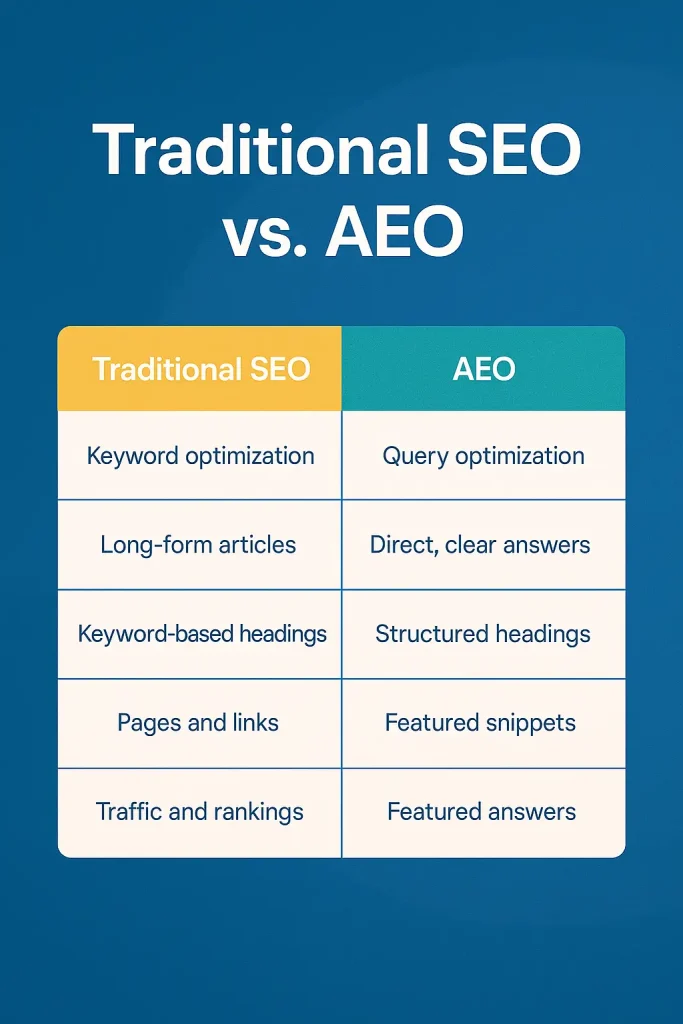
Comparison Table: Traditional SEO vs AEO
| Feature | Traditional SEO | AEO (Answer Engine Optimization) |
|---|---|---|
| Primary Goal | Rank on page one | Get featured as an answer |
| Content Style | Long-form, keyword-focused | Concise, structured, answer-first |
| Optimized For | Search engine algorithms | Voice assistants, AI tools, snippets |
| Formatting Style | Headers, paragraphs, keyword spread | H2s, bullets, FAQs, schema markup |
| Best Use Case | Competitive keywords, blog traffic | Quick answers, featured snippets |
Why You Need Both
Most B2C businesses need to:
Show up for product/service searches (Traditional SEO)
Earn trust and visibility with helpful answers (AEO)
Together, SEO and AEO:
Improve organic reach across devices
Maximize visibility in both Google results and AI platforms
Build authority through structure and relevance
Want blogs that rank and get featured?
I help small businesses write and optimize blog content that shows up in voice search, snippets, and search results. Let’s build a strategy that does both.
FAQs About Answer Engine Optimization and search engine optimisation
What is the difference between SEO and AEO?
SEO is about ranking in search engines using keywords and backlinks. AEO is about answering specific user questions clearly for AI tools and voice search.
Do I need both AEO and traditional SEO?
Yes. Traditional SEO helps with ranking, while AEO helps you appear in snippets, voice search, and AI results. Together, they give you broader visibility.
How do I optimize my blog for AEO?
Use structured content, answer-first formatting, bullets, H2s, and FAQs. Include schema markup and write for voice search.
Is AEO just for AI tools?
No. AEO also improves visibility in Google snippets, voice search results, and People Also Ask sections.
Can you help me write AEO blogs?
- Absolutely. I help small businesses write blogs that rank in search and get featured. Contact me here.
Final Thoughts
Want help making your blog AEO-ready? Contact me to get started or book a free clarity call. Let’s make your content easier to find, understand, and convert.